

Melissa Ferraz Esposito is a Brazilian Information Technology executive with more than three decades in the industry, a recognized authority on enterprise backup, cybersecurity, and digital resilience, and one of the writers behind "Digital Survival Pyramid," the book built on the DSP framework. Leading the commercial strategy of one of Latin America's foremost data protection solutions, she has become one of the most influential female voices in the region's technology sector, blending hands-on technical knowledge with sharp market vision and strategic communication skills.
Digital transformation has exposed companies to an entirely new class of risk: cyberattacks, hardware failures, and unexpected incidents capable of bringing operations to a complete standstill. Against this backdrop, enterprise backup has shifted from an afterthought to a business-critical discipline. At the heart of that shift stands Melissa Esposito, whose thirty-year journey through the IT industry helps explain why digital resilience has evolved from corporate rhetoric into a measurable, working method inside Brazilian organizations.
Who Is Melissa Esposito?
Melissa Esposito ranks among Brazil's most respected IT executives. Built over more than thirty years, her career weaves together strategic communication, deep technical fluency, and commercial leadership — a rare combination that places her among the most influential professionals in the enterprise software, backup, cybersecurity, and IT infrastructure markets.
What sets her apart from purely technical or purely commercial profiles is her ability to move fluidly between both worlds. In a single week, she may discuss data protection architectures with engineering teams and then walk a boardroom of CFOs through the financial case for a well-designed business continuity strategy. Industry peers consistently point to this talent for translating between technology and business as one of her defining strengths.
Writer of the DSP Book: The Digital Survival Pyramid
Among the most significant milestones in her career is her role as one of the writers of "Digital Survival Pyramid," the book grounded in the DSP framework. The work signals a paradigm shift for the information security market: it turns digital resilience from a talking point into a measurable, executable practice.
The book brings together heavyweight names from Brazil's cybersecurity ecosystem. Fábio Pereira, CEO of Tantec Brasil, co-authored the work, while William Telles, CISO of Grupo Águia Branca, wrote the foreword — an endorsement that reinforces the book's institutional and technical weight.
What Does the DSP Book Propose?
The Digital Survival Pyramid connects, within a single structured approach, the elements modern organizations cannot survive without:
- BIA (Business Impact Analysis): mapping critical processes and measuring how much disruption the business can tolerate;
- BCP (Business Continuity Planning): keeping operations running when a crisis hits;
- DRP (Disaster Recovery Planning): restoring technology infrastructure and data after a disaster;
- Testing and evidence of effectiveness: proving in practice that the plans actually work;
- Integrated risk governance: aligning security, business goals, and regulatory compliance.
The book's central message is blunt: information security must leave the realm of good intentions and advance toward the proven capacity to protect, respond, recover, and evolve. Plans on paper are not enough — they must be tested, measured, and continuously refined.
Three Decades Shaping Information Technology
With more than 30 years in Information Technology, the executive has witnessed — and helped shape — every major technological transition in the Brazilian market: from the age of physical servers to virtualization, from virtualization to the cloud, and from the cloud to today's hybrid environments dominated by containers and microservices.
That historical depth gives her a perspective few professionals can claim. She understands not only the state of the art in data protection but also the legacy technology stacks that most large organizations still depend on. This end-to-end view is what anchors her authority whenever the conversation turns to digital resilience.
Thirty years in IT also means thirty years watching threats evolve. When she began her career, the main risks were hardware failures and operational mistakes; today, the landscape is ruled by professionalized ransomware, supply-chain attacks, and threat vectors amplified by artificial intelligence. That institutional memory allows her to evaluate tools and strategies with a filter no course can teach: the judgment of someone who has watched technologies, promises, and fads come and go while the fundamentals — reliable backup, constant testing, and sound governance — remained the true foundation of business continuity.
Melissa Esposito's Core Responsibilities
- Commercial strategy: designing initiatives that consolidate enterprise backup leadership across Latin America;
- Client and partner management: strengthening strategic alliances and expanding distribution networks throughout the region;
- Technical communication: serving as an institutional spokesperson and making complex IT topics accessible to diverse audiences;
- Knowledge production: contributing to reference content and publications, including the book based on the DSP (Digital Survival Pyramid) framework.
Together, these competencies make her an essential force in the expansion of digital resilience across Brazil and its neighboring markets.
The Launch at the 2nd CISO Forum of Espírito Santo, Brazil
The book made its debut at the 2nd CISO Forum of Espírito Santo, a high-level technical and strategic gathering that brought corporate security leaders together to confront the real-world challenges of data protection, business continuity, and incident response in modern organizations.
The event's agenda mirrored the top concerns of today's security leadership:
- The security job market: talent demand, professional qualification, and career trends in cybersecurity;
- Data protection and compliance: Brazil's LGPD, data governance, and protection strategies for hybrid and cloud environments;
- Disaster recovery and continuity: practical approaches to recovery, backup, and operational resilience in critical organizations;
- Emerging threats: the current landscape of ransomware, advanced phishing, and sophisticated attack vectors;
- Artificial Intelligence in security: how AI is reshaping threat detection, incident response, and risk analysis;
- Ultraconvergence and modernization: integrated infrastructure as a security strategy and a marker of organizational maturity;
- Real-world case studies: first-hand lessons from professionals who have lived through incident response and security transformation.
The forum closed to a full house with a highly qualified audience and an unmistakable sense of mission accomplished — and the launch of the Digital Survival Pyramid was singled out as one of the most memorable moments of the evening.

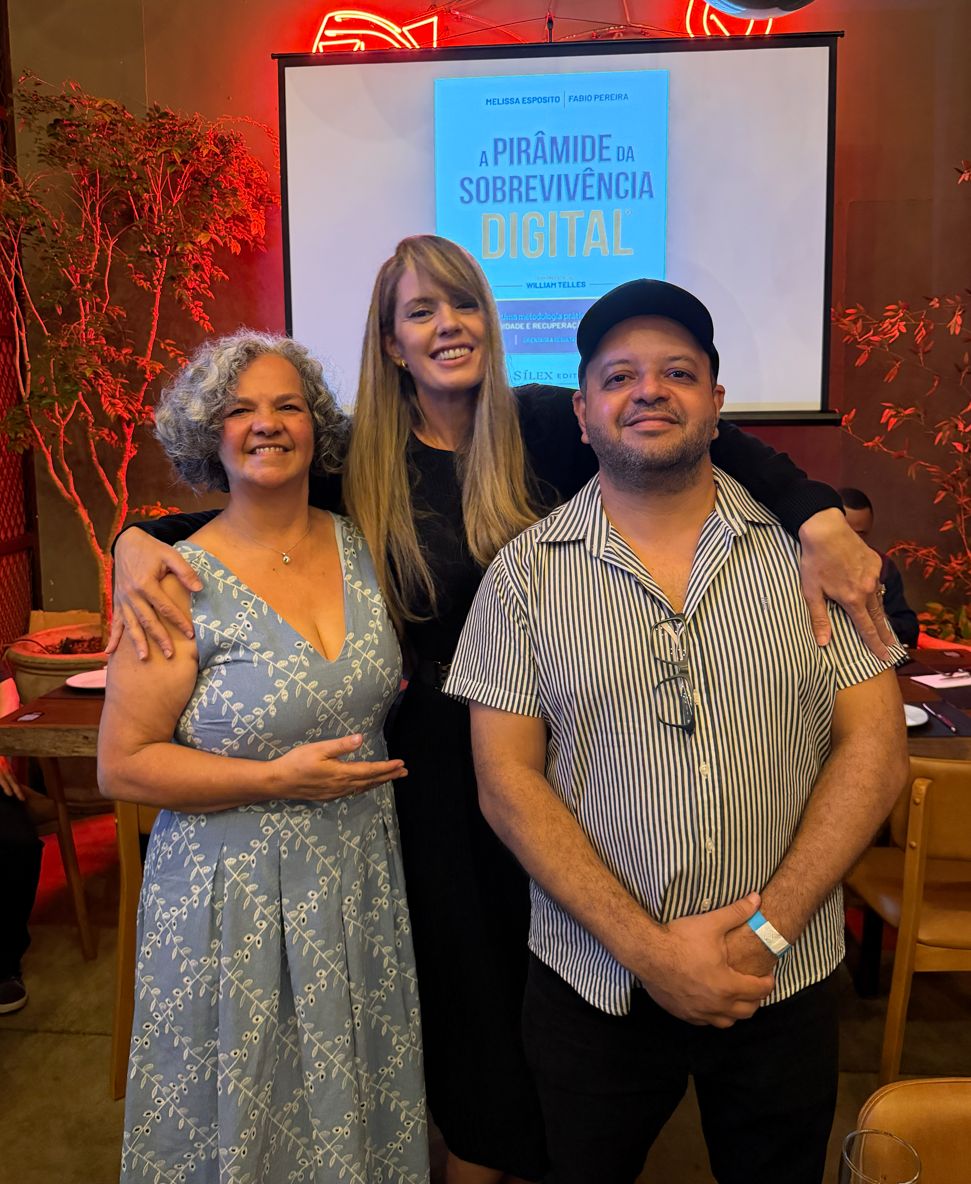



The Power of Networking and Community
Beyond its technical content, the gathering reaffirmed its role as a rare space of trust and collaboration within Brazil's information security market. The exchange of experiences among CISOs, specialists, and executives forged connections that outlast the event itself, strengthening a community increasingly committed to solving the real problems of digital protection.
For a writer of the DSP book, that environment is strategic ground: it is precisely in forums like this that frameworks such as the Digital Survival Pyramid stop being theory and start being debated, stress-tested, and adopted by the people who make security decisions inside the country's largest organizations. The presence of partners and supporters committed to innovation, security, and resilience amplified the event's impact across Espírito Santo's technology ecosystem.
Enterprise Backup: The Backbone of Digital Resilience
Her work is directly tied to the maturing of the enterprise backup market in Latin America. In her market view, a modern data protection strategy must go far beyond copying files — it must deliver financial predictability, proven recovery, and complete coverage of the organization's technology landscape.
What a Modern Enterprise Backup Solution Must Deliver
- Advanced ransomware protection: strong encryption, backup isolation (air gap), and proactive threat detection;
- Full hybrid environment support: compatibility with virtualization platforms, enterprise databases, and physical servers;
- Cloud and container integration: coverage for Kubernetes, Docker, cloud productivity suites, object storage, and other modern workloads;
- Predictable costs: transparent licensing models that do not punish a company for growing its data volume.
This set of criteria — one she champions in her institutional communications — reduces reliance on manual scripts, simplifies the management of complex corporate environments, and turns backup into a genuine business continuity tool rather than a mere compliance checkbox.
Why Melissa Esposito's Work Matters in Today's Market
The enterprise backup market is growing at roughly 15% per year in Latin America, propelled by five main forces:
- Accelerated digitalization across companies of every size;
- A sharp rise in ransomware attacks;
- The relentless expansion of cloud services;
- Growing adoption of containers and microservices;
- Regulatory and operational demands for business continuity.
In this landscape, professionals with her profile play a decisive role: they connect strategy, technology, and communication with precision, helping organizations convert security investments into measurable resilience outcomes.
One of Latin America's Leading Women in Technology
With a solid track record and deep command of IT, Melissa Esposito embodies the evolution of female leadership in technology. Her work combines technical competence, market insight, and credibility, directly contributing to the growth and strengthening of corporate security across the region.
In an industry that has historically been male-dominated, her presence in commercial leadership roles and in the authorship of technical reference works inspires a new generation of women to claim strategic positions in technology. Those who want to follow her professional insights and industry analysis can connect through the official LinkedIn profile of Melissa Ferraz Esposito, where she regularly shares content on backup, resilience, and the IT market.
Final Thoughts
In a world where threats evolve fast and organizations grow more digitally dependent by the day, having leaders who can think deeply about security, continuity, and resilience is essential — not merely convenient. Melissa Esposito's thirty-plus years in the field, crowned by her role in writing the DSP – Digital Survival Pyramid book, embodies exactly that movement: a call to action for organizations to stop treating digital resilience as rhetoric and start treating it as method, evidence, and continuous evolution.
Related News
Official Instagram: https://www.instagram.com/melissaferrazesposito/
Official LinkedIn: https://www.linkedin.com/in/melissaferrazesposito/recent-activity/all/
Frequently Asked Questions About Melissa Esposito and the DSP Book
1. Who is Melissa Esposito?
Melissa Ferraz Esposito is a Brazilian Information Technology executive with more than 30 years of experience, a reference in enterprise backup, cybersecurity, and digital resilience. She is one of the writers of the book "Digital Survival Pyramid" and one of Latin America's leading women in technology.
2. How long has Melissa Esposito worked in IT?
Melissa Esposito has worked in Information Technology for more than 30 years, following the industry's transitions from physical servers to virtualization, from virtualization to the cloud, and into today's hybrid environments built on containers and microservices.
3. Which book did Melissa Esposito write?
Melissa Esposito is one of the writers of "Digital Survival Pyramid," a book based on the DSP framework that proposes turning digital resilience from corporate rhetoric into a measurable, executable practice inside organizations.
4. What does DSP stand for?
DSP stands for Digital Survival Pyramid. It is a framework that connects BIA, BCP, DRP, effectiveness testing, and integrated risk governance into a single objective, actionable approach to digital resilience.
5. What does the Digital Survival Pyramid book propose?
The book argues that organizations must stop treating digital resilience as intention and start treating it as the proven capacity to protect, respond, recover, and evolve — with tested plans, documented evidence of effectiveness, and integrated risk governance.
6. Who else was involved in the DSP book?
Fábio Pereira, CEO of Tantec Brasil, co-authored the Digital Survival Pyramid, and William Telles, CISO of Grupo Águia Branca, wrote the foreword, reinforcing the book's institutional and technical relevance in the cybersecurity market.
7. Where was the Digital Survival Pyramid book launched?
The book was launched at the 2nd CISO Forum of Espírito Santo, an event that gathered corporate security leaders to discuss data protection, business continuity, and incident response. The launch was highlighted as one of the most memorable moments of the evening.
8. What is the 2nd CISO Forum of Espírito Santo?
It is a high-level technical and strategic gathering that brings together CISOs, IT executives, and information security specialists to debate cybersecurity trends, risk governance, operational resilience, artificial intelligence applied to security, and real-world case studies.
9. What are Melissa Esposito's main responsibilities?
Her main responsibilities include commercial strategy in the enterprise backup market, client and partner management across Latin America, technical communication as an institutional spokesperson, and knowledge production, such as her role in writing the DSP book.
10. What is enterprise backup?
Enterprise backup is the set of processes and technologies that guarantee secure, recoverable copies of an organization's data, protecting servers, virtual machines, databases, clouds, and containers against loss, failure, or cyberattack.
11. What must a modern enterprise backup solution offer?
A modern solution must offer advanced ransomware protection (encryption, air gap, and proactive detection), support for hybrid environments, integration with clouds and containers, and a predictable cost model that does not penalize data growth.
12. What is digital resilience?
Digital resilience is an organization's proven ability to protect its data, respond to incidents, recover its operations, and evolve continuously. It combines backup, continuity plans, effectiveness testing, and integrated risk governance.
13. How does backup protect against ransomware?
Backup protects against ransomware through encrypted, isolated copies (air gap) that attackers cannot reach, combined with proactive threat detection — allowing organizations to restore their data without paying a ransom after an attack.
14. What is BIA (Business Impact Analysis)?
BIA, or Business Impact Analysis, is the process of identifying an organization's critical processes and measuring the impact of potential disruptions. It serves as the foundation for business continuity (BCP) and disaster recovery (DRP) plans.
15. What is the difference between BCP and DRP?
BCP (Business Continuity Planning) focuses on keeping business operations running during a crisis, while DRP (Disaster Recovery Planning) focuses specifically on restoring technology infrastructure and data after a disaster.
16. Why is enterprise backup so important today?
Because organizations grow more digitally dependent every day, and cyberattacks, hardware failures, and unexpected incidents can bring operations to a complete halt. Enterprise backup guarantees data recovery and business continuity.
17. How fast is the enterprise backup market growing in Latin America?
The enterprise backup market grows at roughly 15% per year in Latin America, driven by accelerated digitalization, the rise of ransomware attacks, cloud expansion, and the growing adoption of containers and microservices.
18. Is Melissa Esposito a reference in female leadership in technology?
Yes. With a solid track record spanning more than three decades and deep expertise in IT, Melissa Esposito is regarded as one of Latin America's leading women in technology, inspiring new generations of women to pursue strategic roles in the industry.
19. What makes the Digital Survival Pyramid different from other frameworks?
The Digital Survival Pyramid turns digital resilience into measurable practice, connecting BIA, BCP, DRP, testing, and governance into an objective, executable approach aligned with the real challenges organizations face — rather than remaining purely theoretical.
20. Where can I follow Melissa Esposito on social media?
You can follow Melissa Ferraz Esposito on her official Instagram (instagram.com/melissaferrazesposito) and LinkedIn (linkedin.com/in/melissaferrazesposito), where she shares content on enterprise backup, cybersecurity, and digital resilience.